
You are here
Induction Heating
Inductive heating is based on the supply of energy by electromagnetic induction. A coil with suitable dimensions is placed close to the metal parts to be heated. High and medium frequency alternating current flows through it which induces parasitic currents in these parts, the intensity of which can be controlled and modulated
The heating occurs without physical contact and only heats the metal parts being treated. The process is characterised as a high-efficiency transfer without loss of heat.
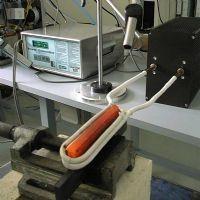
The depth of penetration of the generated current correlates directly to the working frequency of the generator being used. The higher the depth of penetration, the more the induced currents concentrate on the surface. In this case, heating homogeneity on a relevant mass can only be obtained only thanks to the principle of thermal conduction which allows heat to be transferred depth wise.
By decreasing the output frequency, it is possible to increase the penetration of the induced currents within the parts. These currents are capable of reaching the very heart of the mass. This phenomenon is connected to the magnetic permeability and endurance of the material being treated.
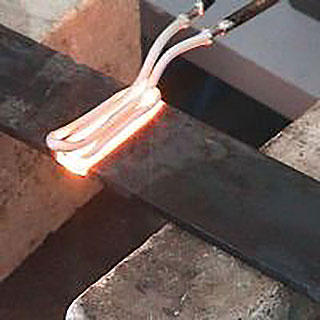
The phenomenon of electromagnetic induction is therefore based on three physical principles:
- Transfer of energy from the inductor to the mass to be heated by means of electromagnetic fields.
- Transformation of the electrical energy into heat due to the Joule effect. The Joule Effect states that the amount of electrical energy depends upon: the square of the electrical current, the resistance of the substance through which current passes and the flow time of the current.
- Heat transmission inside the mass through thermal conduction.